
Cocreation of thought
Introducing a neurodivergent choreography of conversation, with Danielle Jones and Rosie Heafford, part 2

In the first part of Cocreation of thought, I introduced the entangled thought development process that I have been nurturing with Rosie Heafford over the last year and a bit, and how it came about. We talked about neurodivergent communication styles, the benefit of exploring thought in real time with another person, and how this has influenced our ways of working. In this second part of the conversation, we share more insights into the threads that we have explored in our practice, and I introduce the themes in the coming series of essays that I am sharing on ‘Cocreation as a Neurodivergent Practice’.
So how does our continued dialogue impact us…
Rosie
Our conversations have influenced the unfurling of my own neurodivergence which I think I’m still avoiding a label for–partly a hang up on diagnosis, also a fear of feeling trendy, and it has been a slower uncovering because my physical disability has meant that a lot of the accommodations I need are already there, but I maybe hadn’t realized that they were also supporting me with my neurodivergent traits.
Danielle
It’s interesting how the increase in conversation around neurodivergence can have a positive or negative impact on how we view ourselves or our differences. I have found the opposite to be true, as I already had the understanding of my neurodivergence which was such an incredibly affirming realisation for me and has given me so much self compassion. I was exploring supporting my children and myself through this discovery and the dialogue with you helped me process the trauma we were experiencing around school and come to fully accept and embody my values in this area of our lives. I also came to realise my physical needs that come hand in hand with AuDHD, namely my hypermobility (hEDS) and co-occurring issues. Having a connection with you and our conversations around modelling inclusion and access as holistic and whole systems issues was really supportive in giving me the acceptance of this.
Rosie
I can acknowledge autistic, ADHD, PDA parts of myself, dyslexia and sensory processing, and I think the PDA part of myself I have acknowledged much more through conversation with you, because I think it’s been so hidden. But fundamentally for me, talking to a PDA adult to understand my PDA child has been really influential on me as a parent. Little highlights that you’ve identified with your PDA experience have aligned or raised thoughts for me to understand my own neurodivergence. But I think what’s also been incredibly supportive is that there have been times where I’ve been struggling with understanding O, and you have explained things in terms of your child self, and that has given me a lot of validation and clarity around her needs and my relationship with her.
Danielle
Hearing you talk about O in the ways that you have has also helped me with that though. That’s what is so important about this dialogue because through the conversation itself my self knowledge has grown by being able to speak to the challenges that you have raised out loud. Something such as existentialism and the way this shows up in O. Hearing you talk about this then helped me to share about my own experience and the way that poetic writing was helping me to explore and understand existential giftedness.
I think the fact that we are re-writing the narratives around our own childhood experiences, whilst parenting our neurodivergent children through a nervous system lens, and also applying that to ourselves and our self understanding–that is such a special and unique bond that we have, not to mention the choreography of thought and the interweaving of our practice as artists into this self development!
Rosie
Yes, I think a huge influence from you has been bringing in the understanding of my nervous system into this kind of constellation of knowledge. So I’ve been aware for a long time of how, as an artistic leader, the access accommodations I need are not very simple. It’s not just note taking, it’s around capacity, because my full time is less hours than other people. So everyone in my team has to really understand the project, my capacity, my access needs, and that has to filter through everything.
I think the missing piece for me was really around the nervous system and that’s come through the understanding of my PDA experience. I understand now, why when I first identified as disabled almost 10 years ago, I really felt like I wanted a support worker, or I felt like I wanted someone to travel with me, and I always sort out experiences that were with and alongside other people.
But more fundamentally, I cannot create without cocreation. I can’t. It feels abhorrent to me to walk into a room, give someone choreography, tell them to do it and leave, and that actually, my whole way of creating has come from seeking nervous system safety. I think I thought that was ‘community’ that I was seeking, or democracy. But I see that there’s something more fundamental in that for me now.
Danielle
I had exactly the same discovery and I know we both really got excited about this. For me it’s been interesting unpicking my artistic curiosities–from cocreation, to compassion, to collectivity and identity–and recognising that nervous system attunement and coregulation sits at the heart of that.
It was during the making of Kindred (child and parents immersive dance performance 2023-24) that I first identified this was what was taking place. I made the show with my own children present, and I was having to coregulate with them, as well as create a coregulating space with other adults and their children, which is a huge task. But this experience provided a lightbulb moment for me. It gave me an understanding of my practice in new ways and also the language to articulate what was happening from a nervous system lens. I’d always spoken of fostering self compassion in order to develop a compassionate connection with others. But I recognise I was also talking about developing my own nervous system regulation, in order to be a grounded regulating presence for others. I still think compassion has a really vital role in this, but I believe that compassion is fostered when nervous systems are connected. The grounded atunement to one another takes time, but when that coregulation truly drops into place, compassion can be found in abundance.
Rosie
One thing that has evolved in my artistic practice, In conversation with you, is I realised that I had been ignoring the needs of the adult, or I had been focusing only on the needs of the child. Since 2015, when I really started to try and understand and be fascinated by young children, it was mostly framed in my head as “adult ways of being, disrupted the children”. I think, through discussion with you, the coregulation of the adult, and the positioning of the adult and how we might support that, has become more of a priority.
Danielle
Yes and I think this absolutely ties in with my curiosity around compassion. For a long time I’ve worked with adults, sometimes specifically older adults or adults with a disability or health condition. My practice has always been driven by attunement to others and reflection through vulnerability and reciprocity. This, I always described as a practice of compassionate awareness and loving connection. However, I do see this more now as a nervous system coregulation.
When I worked with families, I said I wanted to support parents to compassionately connect with themselves in order to come into attunement with their children. However, I recognised during this process that I was actually saying, I want to support the parents to coregulate with their child, in order to make room for personal growth for the adult, thus leading to the creative freedom we are seeking for the child.
To achieve this as an artist I have to have genuine, authentic interest and respect for the person I’m dancing with, and in their experience of the world–which has to be true for the parent as well as for the child I think.
Rosie
I think the last thing I want to share is that there’s been a real process of validation here. When I felt like someone else should just do my job. There is someone else that could be the artistic leader for second hand dance with less complication–I feel that quite often. But I know that you have validated my role and value–you’ve said words like “but it has to be you”; “There has to be this representation in the sector”.
There’s a need for disabled, neurodivergent allyism, which I seek out with you, and other disabled, artistic friends.
We need to support each other and in doing so we maintain the development and visibility of our work.
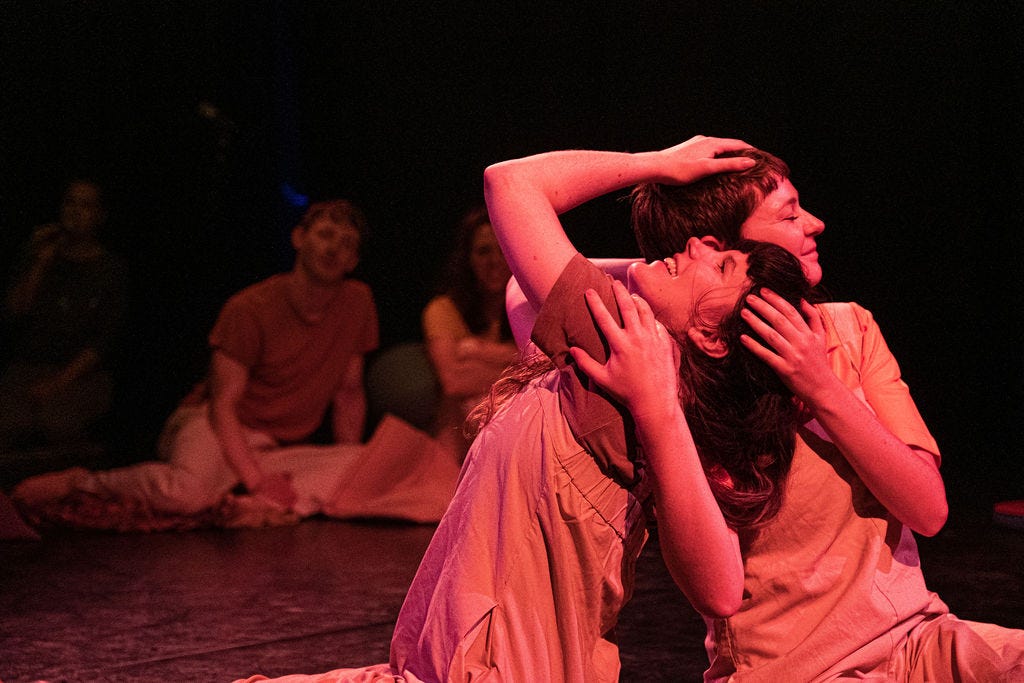
In this dialogue and in the thinking that led to the fostering of this relationship between Rosie and I, was the seed of an idea around neurodivergent practice. What we have begun to share here is how we have both been applying the learning around our neurodivergent traits, to the interrogation of how we practice as dance makers and artists. In the coming weeks, I will be sharing a series of essays on dance and Neurodivergent Practice. The themes I will look at include, the delicate balance of AuDHD as it shows up in my practice, the hierarchy free nature of cocreation and how that is fed by demand avoidance, and the development of cocreated and demand free performance spaces for children and adults.
As always, if you are interested in these ideas please subscribe to my Substack. All essays on life, art, and poetry are available without charge whilst I am growing and sharing this process of dance thinking.